Understand · Ongoing study · Experimental design and map selection
Modeling Communication Dynamics in Complex Strategic Planning
TL;DR
A Unity-based behavioral experiment exploring when communication helps people coordinate through complex, asymmetric planning tasks.
Skills & stack
- 01Behavioral experiment design
- 02Collaborative planning
- 03Python data analysis
- 04Unity
- Affiliation
- Weiji Ma Lab, NYU

Background
The problem
Communication can help collaborators align their plans, but speaking also consumes attention and time. The study asks when that cost is justified in a complex joint-planning task.
What I did
The experiment combines a Unity road-construction game with a Python analysis pipeline that identifies situations where locally greedy and globally optimal plans meaningfully diverge.
Research setup
When is talking worth the cost?
TL;DR I designed the study, built the Unity experiment and Python map-selection pipeline, selected the maps, and collected participant data. Nastaran and Weiji Ma supervised the project. This is an ongoing study; final participant results are not yet available.
01 / Research question
Communication supports collaboration, but not every decision benefits from discussion. The study tests whether people communicate selectively when uncertainty, branching choices, or long-term consequences increase.
- Selective communication: Do people speak more when the next move is difficult to predict?
- Communication benefits: Does talking improve planning by clarifying intent and repairing mismatched expectations?
- Communication biases: When does discussion create over-coordination or unequal contribution?
02 / Experimental task
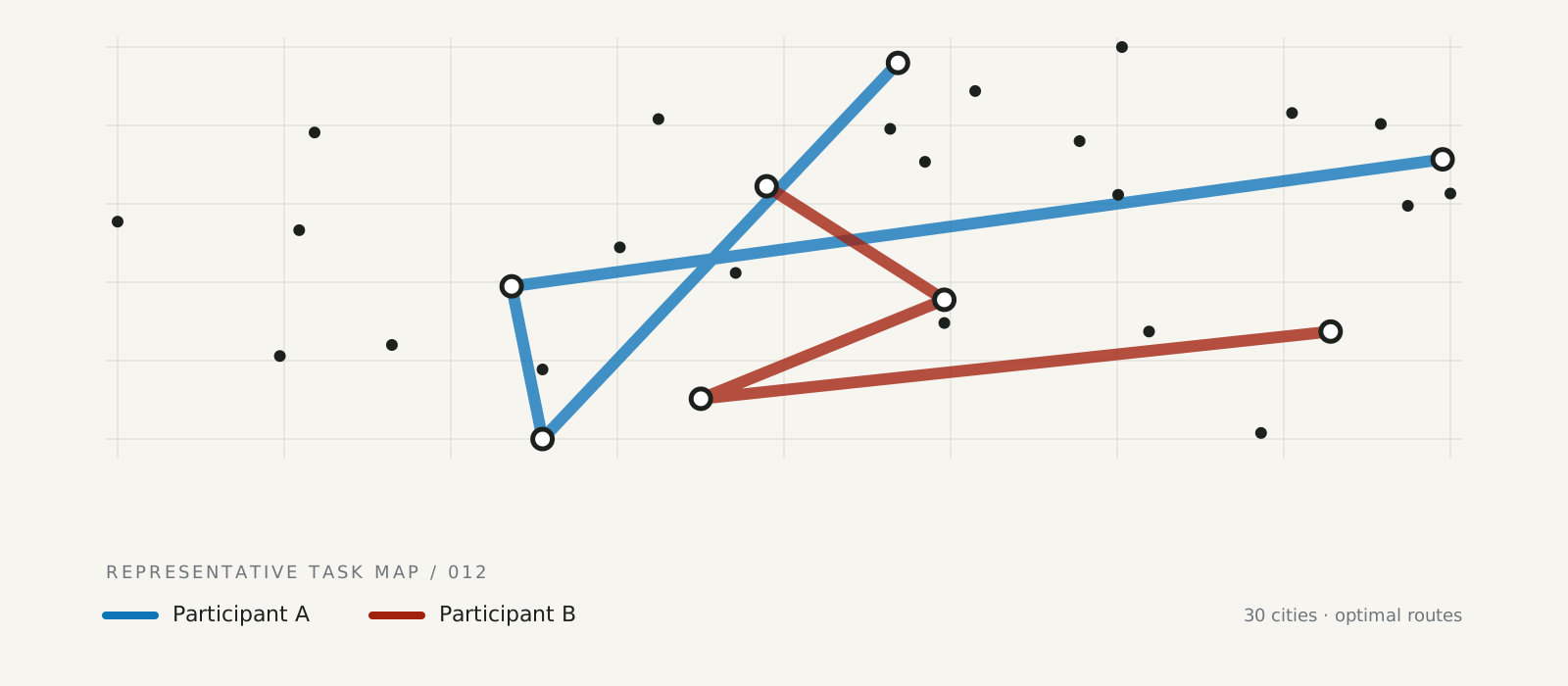
Two participants plan roads across the same map in a Unity-based game. Each map creates a different strategic environment, allowing communication behavior to be connected to the structure and difficulty of the decisions being made.
The experiment is designed to capture gameplay and communication together, including when participants speak, what action follows, and whether their joint plan improves.
03 / Selecting informative maps
The analysis pipeline evaluates 1,242 candidate maps under two strategies: greedy, which chooses the locally best move, and optimal, which produces the best overall result.
Maps are filtered using starting-position distance and contribution balance, then compared through measures such as tree depth, number of possible paths, optimal solutions, and each player’s contribution. Selected maps are exported into training and evaluation blocks for use in the game.
Pipeline Candidate maps → greedy and optimal comparison → balanced study set → Unity experiment
04 / Current scope
The repository documents the hypotheses, map data, selection notebooks, visualization code, game-asset export pipeline, and current study implementation. The current phase is study execution and data collection.
The next analysis will test whether communication improves coordination at strategically difficult moments—and when the cost of talking outweighs its benefit.